

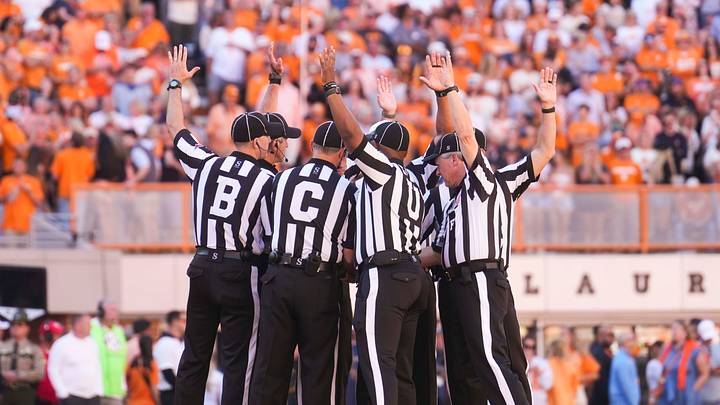
In what is becoming the new norm, a new college football season brings some new rule changes for the 2026 season. There are going to be a handful of new rules that fans will learn quickly, and here are some of the big ones that Virginia Tech fans will want to know.
Virginia Tech fans will need to get used to some new college football rules for 2026
Targeting penalty
One of the most frustrating rules for fans is how targeting is called. There are times when it is called and goes to replay, and the call is upheld. There are also times when it's not targeting, and the player can stay in the game. For the 2026 season, the targeting penalty change will be an experimental rule.
The new rule states that upheld calls will now eliminate the carryover disqualification for fouls committed in the second half. If a player is kicked out of the game in the first half, he's out of the game, same as last year. Now, if a player is kicked out for targeting in the second half, they won't have to sit the first half of their next game. If a player gets a second targeting foul within teh same season, the player will not only be kicked out of the current game, but will also miss the first half of the next game.
If there is one rule that has been called inconsistently, it's targeting. It's to the point that fans are confused about what is and what isn't a penalty. Forcing a player to miss the first half of their next game for a targeting call in the second half of a game was a silly rule. This is one rule that could be huge for college football.
Modernizing unsportsmanlike conduct rule
Maybe the next confusing rule, in terms of how it's called, behind targeting is unsportsmanlike conduct. Honestly, it is a flip of a coin as to how it's called. Everyone's interpretations are different. That's not great for the sport.
College football is minimizing the list of unsportsmanlike conduct to five actions/gestures. They are,
- Any form of gun violence, including brandishing a weapon.
- A slashing of the throat or a nose-wipe signal.
- A player removing their helmet after the ball is dead (with exceptions for timeouts and equipment adjustments).
- Dead-ball contact fouls, such as pushing, shoving, striking, etc., that occur clearly after the ball is dead and that are not part of the game action.
- After the ball is dead, using forcible contact to push or pull an opponent off the pile.
So, if we're being honest, there isn't anything here that is surprising; however, the way these things are interpreted is going to be different by different officials. Again, all fans want is consistency, and they don't always get it. It feels like inconsistency with this rule, even if it's being modified, is going to continue from official to official.
Kick fair catch rule
The Fair Catch Kick is being introduced into NCAA playing rules and will allow the receiving team to attempt an uncontested field-goal-type place kick and score three points under certain conditions. Those conditions are a number of them, but this allows teams to have a chance for a "free kick," which must be a field-goal-type place kick with a holder (no tee) or a drop kick, and if the kick passes over the crossbar and through the uprights, a field goal is scored and three points are awarded to the kicking team.
That is a rule that James Franklin and Virginia Tech could make good use of with John Love's huge leg in 2026. If the right opportunity presents itself, don't be surprised to see the Hokies give it a shot at the right time. Love's leg is very underrated outside of Blacksburg.
Additional coaches replay challenge
This is something that might slow the game down, but in the overall big picture, it is about getting the call right on the field. The rule is still the same: a coach must take a timeout to initiate a challenge, but they get a second challenge in 2026 and will get a third if either of the challenges is overturned. Again, is this potentially going to slow some games down? Yes, but isn't it about getting the calls right on the field rather than speeding up the game and getting it wrong?
Play clock management after a replay review following the two-minute warning
As fans know, replay reviews in the final two minutes of the second and fourth quarters are only initiated by the replay official. However, when it occurs, the play clock will be frozen, and when the ball is signaled as ready for play, it will start from that point. If the play clock is frozen when that occurs below 10 seconds, the play clock will be reset to 10 seconds. That prevents teams from running 25 seconds off the clock when the ball is back in play. This is a nice modification that fans are going to like, and teams are going to have to adjust to it if they are in the lead and looking to burn precious seconds.
 Add us as a preferred source on Google